














The Japanese Covered Bridge, known in Vietnamese as Chùa Cầu (also called the Japanese Bridge or Lai Viễn Kiều), is a monument of exceptional historical, cultural, architectural, and artistic value, and one of the most distinctive symbols of the Hoi An World Heritage Site. For local residents, it is deeply woven into memory and spiritual life; for visitors, it is an unmissable stop on any journey of discovering the ancient town.
A 400-YEAR JOURNEY OF HOI AN’S ICONIC LANDMARK
From the late 16th century, Hoi An had already become a bustling international trading port, attracting a large number of foreign merchants, especially Japanese and Chinese communities. In this prosperous trading context, around the late 16th – early 17th century, Japanese merchants built a small wooden bridge over a narrow canal flowing into the Thu Bon River to connect the Japanese quarter with the Chinese quarter. At first, the bridge functioned both as a passageway and as a resting place where merchants and locals could pause, relax, and enjoy the view of the busy harbor.
On a spiritual level, the bridge was regarded as a protective charm for Hoi An. A small shrine was built in the middle of the bridge to worship a guardian deity, with the hope of warding off disasters and bringing peace to the town. Local Hoi An folklore and Japanese legends both tell the story of Namazu – a giant, catfish-like sea monster whose head lay in India, body beneath the land of Vietnam, and tail reaching all the way to Japan. Every time Namazu thrashed its tail, earthquakes and floods would strike all three places. The Japanese Covered Bridge is likened to a sacred sword driven into the monster’s back, pinning it down so it can no longer stir and cause natural calamities. Thanks to this, people are able to live in peace and the port town of Hoi An enjoys prosperity and smooth sailing in trade.
Such legends and beliefs connected with the bridge enrich its spiritual meaning, leaving a strong impression on visitors and deepening appreciation for Hoi An’s unique folk culture.
Over more than 400 years, the bridge has undergone numerous restorations and conservation efforts. Today, the successful restoration and “revival” of this over-four-century-old structure not only preserves the “soul” of the ancient town, but also further cements the bond of friendship between Viet Nam and Japan. It allows visitors to fully admire the bridge’s original beauty and opens the door to deeper cultural and historical experiences when exploring Hoi An Ancient Town.

ARCHITECTURAL BEAUTY AND CULTURAL VALUES OF THE JAPANESE COVERED BRIDGE
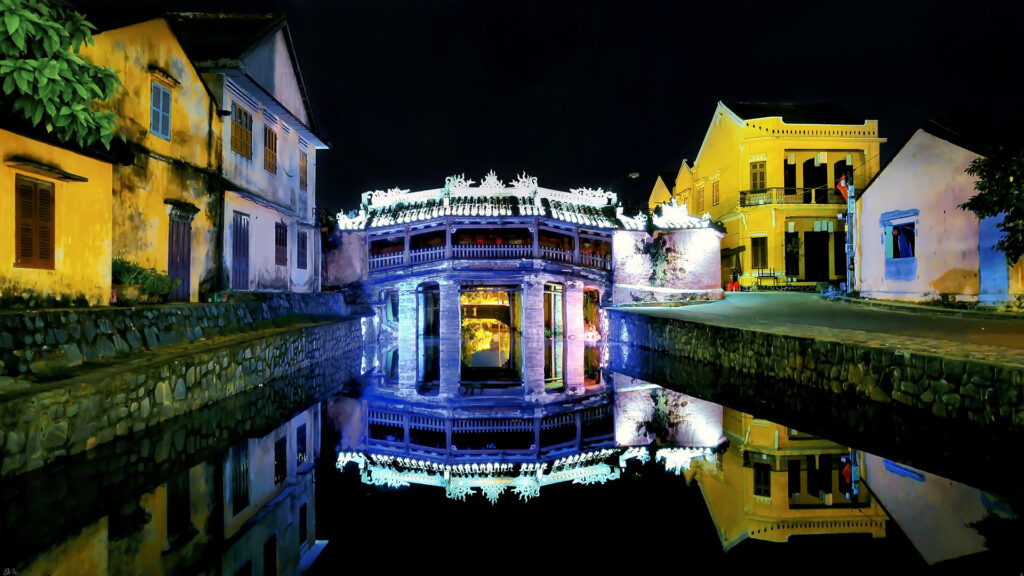
The Japanese Covered Bridge is an architectural gem built in a rare “house above, bridge below” (thượng gia hạ kiều) style. The structure is about 18 meters long and 3 meters wide, with its entire frame made of precious wood and a traditional yin-yang tiled roof arching gracefully over the span.
Overall, the bridge comprises three main parts: two short approach sections on land at either end (each composed of three brick-and-stone arches) and a central section of five spans crossing the waterway, supported by stone piers driven into the canal bed. The bridge deck and the small shrine built on it are separated by a wooden partition in the traditional thượng song hạ bản style: the upper half is latticed, while the lower half is solid—a familiar architectural feature in Hoi An’s old houses.
Many components and details of the bridge are finely carved. Some beams and roof purlins still preserve delicately raised Chinese characters, while the tiled roof edges are decorated with 19th-century blue-and-white ceramic fragments inlaid along the ridges and eaves—adding both artistic flourish and structural durability.
At the center of the bridge is a small shrine. Although commonly called a “chùa” (pagoda), it does not worship the Buddha. Instead, it venerates a lacquered and gilded wooden statue of Bắc Đế Trấn Vũ (Xuanwu), a solemn Taoist deity believed to have the power to subdue storms and floods and protect the land.
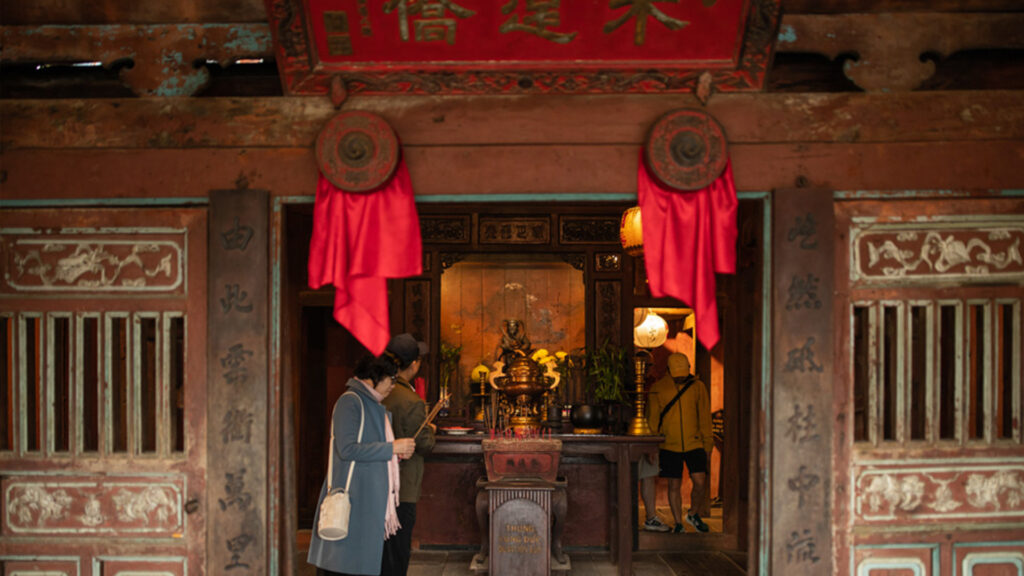
Hanging at the front of the shrine is a gilded wooden plaque inscribed with the three Chinese characters “Lai Viễn Kiều,” a name bestowed by Lord Nguyễn Phúc Chu as a ceremonious greeting to travelers from afar visiting this land. Just below the plaque are two round “door eyes” fashioned from wood, reminiscent of the ornamental knobs seen on old Hoi An doors. These “eyes” symbolize the vigilant gaze that wards off evil and safeguards peace for the dwelling.
At each end of the bridge stands a pair of gilded wooden animal statues representing a monkey (linh hầu) and a dog (thiên cẩu), both in a kneeling, guardian posture. In popular belief, these are the sacred protectors of the Japanese Covered Bridge, revered over centuries. The exact origin of this pair remains something of a mystery, though one widespread explanation suggests that construction began in the Year of the Monkey and finished in the Year of the Dog. The two animals were therefore carved as symbolic markers of this timeline and as spiritual guardians, ensuring the bridge would endure over time.
In many ways, the Japanese Covered Bridge is a masterpiece born from rich cultural crosscurrents. Architecturally, it harmoniously blends Vietnamese, Japanese, and Chinese building traditions. Spiritually, it weaves together indigenous and foreign elements into a uniquely balanced whole.
For generations, Hoi An residents have regarded the Japanese Covered Bridge as a sacred structure intimately linked to their religious life. On full moon days and festive occasions, locals often come to the small shrine on the bridge to offer incense and pray for peace, good fortune, and well-being for their families and for the town.
After more than four centuries, this ancient bridge still stands firm as a timeless emblem of Hoi An—a symbol of Viet Nam–Japan friendship and a source of pride for countless generations of residents. The Japanese Covered Bridge is not only an architectural and artistic treasure, but also a site of profound historical and spiritual depth, truly deserving of its reputation as the “soul of heritage” in old Hoi An.

Notably, the image of the bridge appears prominently on Viet Nam’s 20,000 VND polymer banknote, underscoring its significance and enduring appeal as a more-than-four-hundred-year-old cultural icon.
ESSENTIAL INFORMATION FOR VISITORS
- Admission: The Japanese Covered Bridge is included in the Hoi An Ancient Town entrance ticket.
- Access around the bridge: The surrounding area is open all day, and visitors are free to view and take photos of the exterior at any time.
- Opening hours for walking on the bridge and entering the shrine:
Morning: 9:00 – 11:00
Late afternoon & evening: 15:00 – 22:00 - A few notes when visiting:
- If the bridge is at capacity, visitors may be asked to queue and wait for their turn.
- The Japanese Covered Bridge is a sacred site; visitors are expected to dress modestly, behave respectfully, keep noise to a minimum, and avoid littering.
- Due to the bridge’s small size and limited load capacity, only up to 20 visitors are allowed on the bridge at any one time.


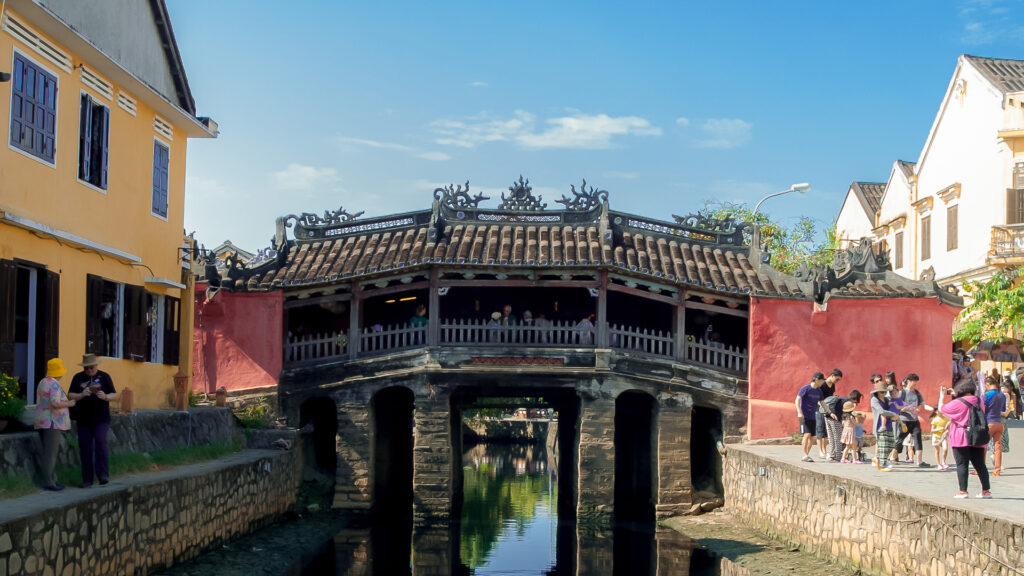
Beyond its remarkable historical and cultural value, the Japanese Covered Bridge is also one of Hoi An’s most beloved “check-in” spots. Amid the poetic landscape of the ancient town, the modest yet captivating bridge becomes the backdrop for countless memorable photos. Every moment captured here turns into a cherished memory in each traveler’s journey. Thanks to its harmonious blend of architecture, culture, and symbolic meaning, the Japanese Covered Bridge will always be worthy of its title as the “soul of heritage” in Hoi An.
DANANG TOURISM PROMOTION CENTER