















The Craft of Bamboo and Coconut House Construction in Cam Thanh, Hoi An has been recognized as a National Intangible Cultural Heritage.
Cam Thanh is a rural village located to the southeast of Hoi An City (now part of Hoi An Dong Ward), about 3 km from Hoi An Ancient Town – a World Cultural Heritage site. It covers an area of approximately 970.42 hectares, of which more than one-third, or 348.69 hectares, is waterways.
NATURAL CONDITIONS AND ECOLOGICAL ENVIRONMENT
This land is surrounded on all sides by waterways: to the south and southwest lies the lower Thu Bon River; to the east and northeast, the Ba Chuom River; and to the north and northwest, the Do River. The Dinh River and the Do River connect the Thu Bon River with the Ba Chuom River along a southwest–northeast direction. The area is interlaced with river branches and canals, varying in width and depth, winding through alluvial flats, sandbanks, and mounds bordered by lush nipa palm groves such as Thuan Tinh (Kien Islet), Ong Hoi Islet, Tien Islet, Ba Xa Islet, Hi Mound, and Gia Mound, creating an exceptionally picturesque and poetic landscape.
Perhaps because it lies close to the Cua Dai estuary, where three major rivers of Quang Nam (Chien Dan, Thu Bon, and Vu Gia) converge with the Co Co River, Cam Thanh possesses a highly distinctive ecosystem: an estuarine mangrove forest characterized by nipa palms.
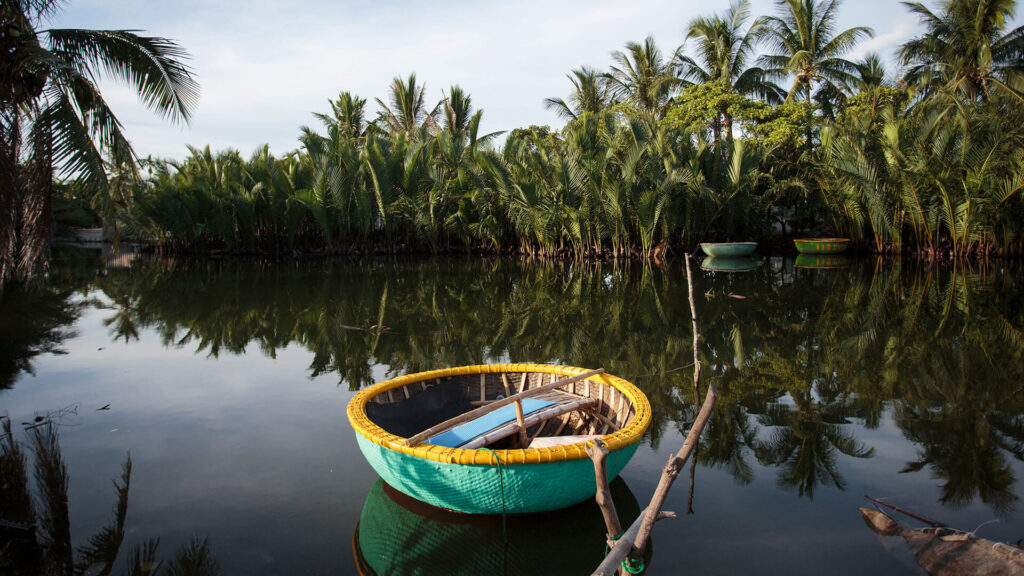
The nipa palm mangrove ecosystem here provides an ideal environment for many species of birds and aquatic life to thrive, contributing to the biodiversity that led to Cu Lao Cham – Hoi An being recognized as a World Biosphere Reserve in 2009. At the same time, it has also created a rugged terrain of strategic importance in defending and protecting the coastline and river estuaries.
In addition to nipa palms, bamboo also grows abundantly in the rural landscape of Cam Thanh. Bamboo groves stretch along riverbanks, village paths, gateways, and garden edges, not only enhancing the charm, tranquility, and serenity of Cam Thanh’s countryside but also supplying essential raw materials for the crafting of household items and the construction of houses.
With its favorable natural conditions and geopolitical, military, and economic position, Cam Thanh has long been a place where successive generations of inhabitants came to settle, cultivate, and develop the land into prosperity. Although heavily devastated by war, the area still preserves more than 23 relics and remains of archaeological, historical, and artistic-architectural value from various periods, classified at both national and provincial levels. These include Cham architectural foundations and Ba Mausoleum, the Ancestral Shrine of the Bird’s Nest Craft, Tra Quan Mausoleum, the ancient tomb of the consort of King Quang Trung, ancestral tombs of the Tran, Le, and Ho clans, ancient wells, and more.
With its favorable natural conditions and geopolitical, military, and economic position, Cam Thanh has long been a place where successive generations of inhabitants came to settle, cultivate, and develop the land into prosperity. Although heavily devastated by war, the area still preserves more than 23 relics and remains of archaeological, historical, and artistic-architectural value from various periods, classified at both national and provincial levels. These include Cham architectural foundations and Ba Mausoleum, the Ancestral Shrine of the Bird’s Nest Craft, Tra Quan Mausoleum, the ancient tomb of the consort of King Quang Trung, ancestral tombs of the Tran, Le, and Ho clans, ancient wells, and more.
The Cam Thanh nipa palm forest, covering an area of 106.01 hectares and concentrated in the hamlets of Thanh Tam, Thanh Nhat, and Van Lang, is popularly known as the Bay Mau Coconut Forest. Lush and verdant all year round, it not only serves to shield against waves and winds, retain alluvial deposits, and regulate the climate, but also provides dried palm leaves which, together with bamboo, have long supplied the raw materials for the formation and development of The Craft of Bamboo and Coconut House Construction — meeting the residential needs of the local community and, more recently, the construction of green tourism facilities.
HISTORY OF THE FORMATION AND DEVELOPMENT OF THE CRAFT
From preserved records and recollections, it is known that between the 16th and 18th centuries, with their advantages and experience in navigating waterways and being located adjacent to the international trading port of Hoi An, the ghe bầu trading craft of Thanh Chau Village flourished. It established trading routes along the central coast and even extended as far as the southern region. Recognizing that the village’s mangrove wetlands could support the growth of nipa palms similar to those in the south, ghe bầu merchants brought seedlings back to plant, which gradually developed into the vast nipa palm forests seen today. Along with introducing the seedlings to this new land, they also acquired and adopted the knowledge of using nipa palm leaves for house construction.
Based on the availability of local materials — bamboo for the structural framework and nipa palm leaves for walls and roofing — and with a spirit of diligence and creativity, the people of Cam Thanh developed The Craft of Bamboo and Coconut House Construction to an ever-expanding scale. It not only met local needs but also served residents of neighboring areas, while at the same time preserving the values of the traditional bamboo-and-coconut house and innovating new forms and products to serve tourism and contemporary aesthetic demands.
The vigorous development of this craft in Cam Thanh gradually spread its influence to other localities such as Cam Chau, Cam An, and Cam Kim.
MATERIALS AND TOOLS
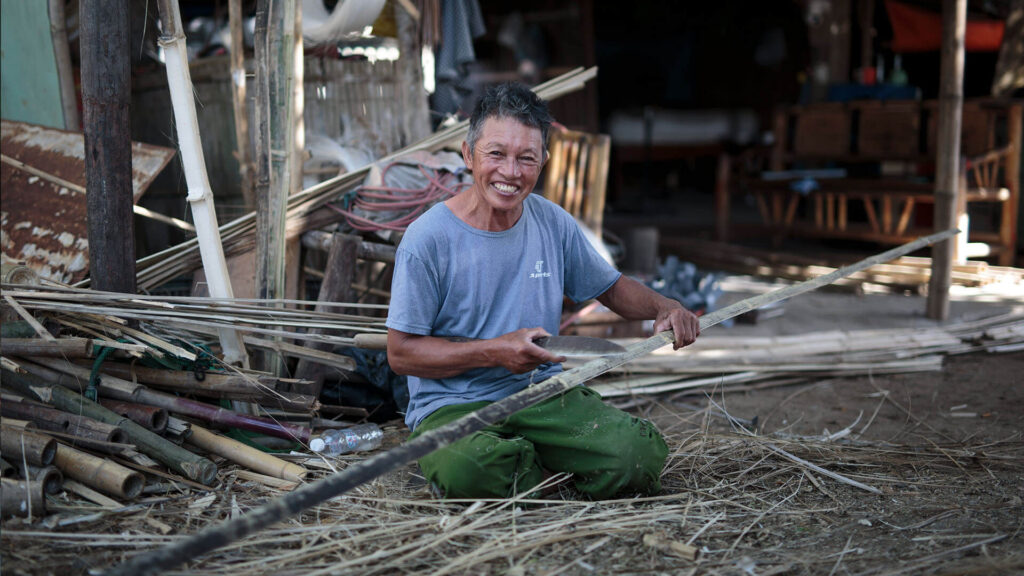
Specializing in The Craft of Bamboo and Coconut House Construction, the people of Cam Thanh created a remarkably diverse system of tools, with more than 40 types used throughout the various stages of the craft — from preparing bamboo and nipa palm materials, processing the structural framework and leaf panels, to assembling and completing the house. Some tools are employed across multiple stages of production. Each stage requires specific skills and techniques, along with secret know-how, to produce a house that is both aesthetically pleasing and durable.
Specializing in The Craft of Bamboo and Coconut House Construction, the people of Cam Thanh have developed a rich system of tools, with more than 40 types used in different stages of the craft — from preparing bamboo and nipa palm materials, processing the structural framework and leaf panels, to assembling and completing the house. Some tools are employed across multiple stages of production. Each stage requires its own skills and secrets, ensuring that the finished house is not only beautiful but also long-lasting.
The preparation of high-quality bamboo and nipa palm materials is one of the most important factors in producing a durable and beautiful house. To ensure strength and resistance to termites, craftsmen usually select mature bamboo that is 4–5 years old. The best time for harvesting is in the first lunar month, when the bamboo has accumulated the most nutrients.
After cutting, the bamboo is submerged in the mud and water of local canals for about one to one and a half years to increase durability and termite resistance. It is then retrieved for processing into structural frameworks, strips for leaf panels, or woven walls. Villagers dig long pits along the canals, carefully stack the bamboo inside, secure it with stakes, cover it with nipa palm leaves, and then bury it with soil on top.
According to the artisans of The Craft of Bamboo and Coconut House Construction, in Cam Thanh, nipa palms that grow on sandy soil have firmer stalks, a slightly pinkish hue, and greater durability compared to those grown in muddy soil; hence, they are preferred for roofing. Nipa palms can be harvested for leaves after five years of growth, with two harvests per year, in the third and eighth lunar months. Farmers use a cleaver to cut down mature leaves while leaving the young leaves and shoots (giao) for the next season. Leaves harvested in the third lunar month are of higher quality than those in the eighth, as they have had a longer growth period.
To make cutting and transporting more efficient, people usually cut from the outside toward the center of the grove. Along with cutting the leaves, they also remove some old stalks to clear pathways. In the past, these stalks were dried and used as fuel for cooking. After cutting, the nipa fronds are dragged ashore or loaded onto boats for transport to the processing area. Depending on whether they are to be used for roofing sheets or wall panels, the fronds are skillfully split into stalks and leaves or into two halves (kien) through deft, well-practiced techniques passed down over generations. Large fronds are usually chosen so that stalks and leaves can be separated. The leaves are then strung together into panels.
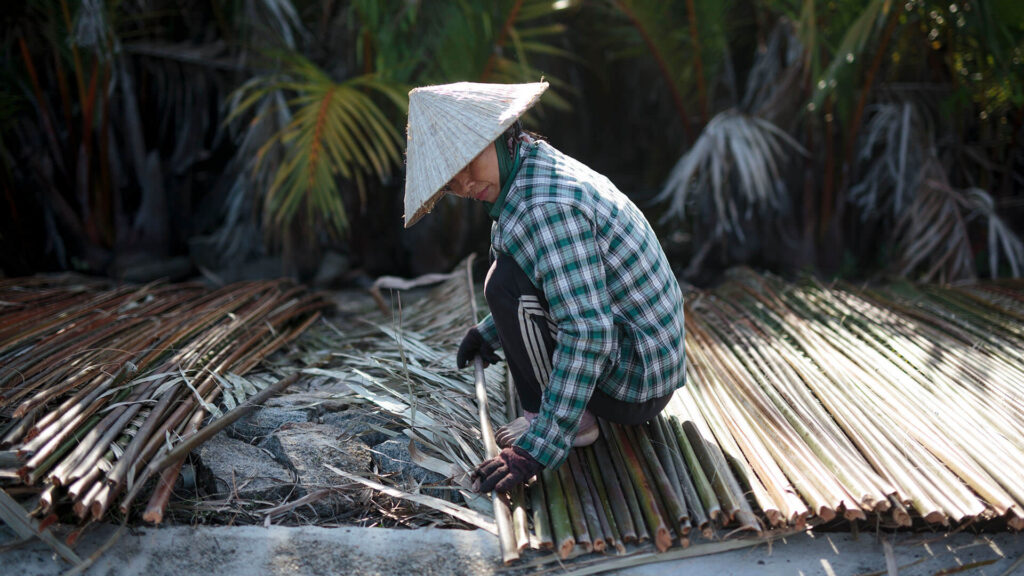
The stalks, leaves, and split kien are dried and bundled, then stored in dry places. To ensure even drying and facilitate processing, villagers lay the kien in the same direction, close together, with the stalks on top and the leaves underneath, tying them in groups of 50 for marking. Drying time depends on weather conditions, ranging from 10 to 20 days. Bundling the dried fronds for preservation is also considered an art, requiring meticulousness and care to prevent breakage and ensure the stalks remain straight. To achieve neat bundles, villagers align the fronds in the same direction, thread coconut-fiber cords through both ends, and tie them tightly.
After drying, the leaves can also be soaked in well-ventilated water areas for about a week and then redried to increase durability and resistance to pests. The stalks are used to make walls, partitions, inner roof linings, and ceiling panels. The leaf panels (tam la cham) are used for roofing doors, sheds, umbrellas, and raincoats. The split kien are bundled into sheets for roofing and paneling.
PROCESS OF BAMBOO AND COCONUT HOUSE CONSTRUCTION
A traditional bamboo-and-coconut house, whether in the three-bay or five-bay style, with or without side wings, is composed of two main elements: a bamboo structural frame (columns, beams, tie-beams, rafters, and ridgepoles) and an enclosing system (roof, walls, and doors made of nipa palm leaves), built upon elevated ground.
To construct a complete house, the preparation of materials is of utmost importance. The craftsman must have a thorough understanding of the structure of a traditional bamboo-and-coconut house, the required scale, and the elevation of the foundation compared to the surrounding ground, in order to properly select bamboo for columns, beams, rafters, and ridgepoles, and nipa palm leaves for roofing panels, walls, and doors. This process involves not only technical skills but also a rich body of knowledge accumulated by artisans and the community over centuries of practice.
Bamboo that has been soaked for the required period is retrieved and dried before being processed into structural components of the house. Long, straight, and evenly sized bamboo culms are set aside for rafters. In folk belief, the ridgepole is considered the “spine” of the house; hence, selecting bamboo for this element requires great care. The bamboo must be of moderate age — neither too old nor too young, as the saying goes, “old bamboo dies early, young bamboo dies young.” The culm must be large, straight, with intact nodes, and not truncated.
Alongside the processing of structural components for the load-bearing frame, the preparation of roofing panels, walls, partitions, and doors is also carried out. The roofing panels (tam tranh) come in different types such as tranh hai, tranh ba, and tranh tu, depending on the number of nipa frond layers used. Based on the size and area of the house, the craftsman selects fronds of similar length to assemble into roofing sheets.
With meticulousness and skill, the artisan uses hand tools to align the nipa fronds, fastening them together with bamboo strips (nep, lui) and binding them with rattan fibers (later replaced with nylon cord) to create sturdy roofing sheets, each about one meter wide.
With meticulousness and skill, the artisan uses hand tools to align the nipa fronds, fastening them together with bamboo strips (nep, lui) and binding them with rattan fibers (later replaced with nylon cord) to create sturdy roofing sheets, each about one meter wide.
The woven wall panels (phen vach) surrounding the house are crafted in various styles, such as leaf panels, leaf-and-stalk panels, yin-yang panels, single-layer stalk panels, or multi-layer leaf panels. Depending on their intended placement, the size and weaving pattern of the panels are adjusted accordingly. They can also be fashioned into different designs, such as solid panels, panels with door or window openings, or panels with ventilation slots.
Components of the house such as gia thu (partition panels) and storm doors are crafted alongside the preparation of wall panels. Their frames are made of split bamboo or rattan, or securely fastened with bamboo pegs, and the exterior is covered with layers of thatched nipa palm leaves, applied from bottom to top. Another element made from nipa leaves is the phong panel, used to cover the ends of the rafters.
The assembly of the house is a crucial stage in the practice of The Craft of Bamboo and Coconut House Construction in Cam Thanh, requiring the coordinated effort of many craftsmen.
To prepare for the assembly, the load-bearing structural components are transported to the elevated foundation where the house will be built. The craftsmen first join the beams (keo) and tie-beams (ruong) together using bamboo pegs (con se), then bind them to the ridgepoles (don dong) and rafters (don tay) with rattan fibers or nylon cords, forming the roof frame.
According to folk belief, the total number of ridgepoles and rafters used in constructing the roof must always correspond to a “life number” (so sinh), with each roof typically having 4 or 6 rafters. Moreover, as the east (the left side) is considered auspicious, the bases of the ridgepoles and rafters at the back roof are always placed to the left. The length of the ridgepoles is also determined according to auspicious measurements on the Lo Ban ruler.
The rear row of bamboo columns is set in advance into post holes about one meter deep. Using bamboo ladders and support poles, the craftsmen lift the roof frame onto the column tops and secure the joints between the columns and beams with bamboo pegs. The same method is applied to the front row of columns. A system of bamboo props is then used to stabilize the frame, after which the craftsmen carefully adjust the height and spacing before firmly embedding the bases of both front and rear columns and erecting the main columns. If the house includes side wings, the framework for these sections is assembled next.
Once the structural frame is firmly secured, the craftsmen begin roofing the house. Each nipa palm panel is lifted up and tightly fastened to the rafters and ridgepoles, following the sequence of attaching the lower rows of tranh panels first, then the upper rows, working from left to right. Next, dried nipa palm fronds are laid flat along the ridge, bound with a long bamboo strip to hold them in place.
After the roofing is complete, the craftsmen assemble the gia thu partitions, the phong panels, and then erect the wall panels and fit the windows and doors. Most windows and doors in bamboo-and-coconut houses are made in the style of drop-down shutters (cua chong). The shutter bars also serve to secure the doors when they are lowered.
CULTURAL AND SOCIAL VALUES
The formation and development of The Craft of Bamboo and Coconut House Construction in Cam Thanh not only testifies to the region’s long-standing historical and cultural traditions but also reflects the ecological and natural characteristics of the area. The people of Thanh Chau in the past, and Cam Thanh today, with creativity and skillful hands, have overcome difficulties and made use of nature’s advantages to serve daily life — and the enduring values of this craft are living proof of that.
Although there is no specific guild founder or distinct system of worship practices, families and establishments engaged in bamboo-and-coconut house construction have actively participated in communal ceremonies such as peace-praying rituals and ancestor veneration, wishing for favorable weather, village harmony, and, in particular, the prosperous growth of the craft.
The contributions of this craft to the treasury of Hoi An’s intangible cultural heritage in particular, and the nation’s in general, include a body of knowledge and experience related to the use of natural resources and dwelling culture, as well as the enrichment of the national language through the craft’s specialized terminology. Through its practice, the community has not only accumulated experience to improve efficiency and create more durable and beautiful houses but has also continually innovated, producing new products suited to contemporary needs and market demands, while attracting tourists to participate and enjoy hands-on experiences with enthusiasm and fascination.
Recognizing the value of the Cam Thanh nipa palm ecosystem for economic development, particularly tourism, as well as the need to preserve and promote the traditional bamboo-and-coconut craft in the modern context, Hoi An City has implemented numerous policies to protect and enhance the Cam Thanh nipa palm ecosystem. These efforts focus on developing community-based tourism rooted in traditional crafts — especially The Craft of Bamboo and Coconut House Construction — along with training and transmission of the craft to future generations.
The inventory, identification, and proposals for the preservation and promotion of cultural heritage values in general, and The Craft of Bamboo and Coconut House Construction in particular in Cam Thanh, have been given attention and carried out at an early stage by Hoi An’s specialized agencies.
The inventory, identification, and proposals for the preservation and promotion of cultural heritage values in general, and The Craft of Bamboo and Coconut House Construction in particular in Cam Thanh, have been given attention and carried out at an early stage by Hoi An’s specialized agencies.
The Craft of Bamboo and Coconut House Construction in Cam Thanh embodies the unique characteristics of Hoi An, found nowhere else. It represents not only the creative use of natural resources to serve daily life but also the refinement of craftsmanship that has made significant contributions to Hoi An’s cultural heritage as well as to local and national socio-economic development.
With appropriate policies from the Hoi An city authorities, together with the diligence, meticulousness, and innovative spirit of the community, it is believed that the products of this craft will continue to gain renown far and wide.
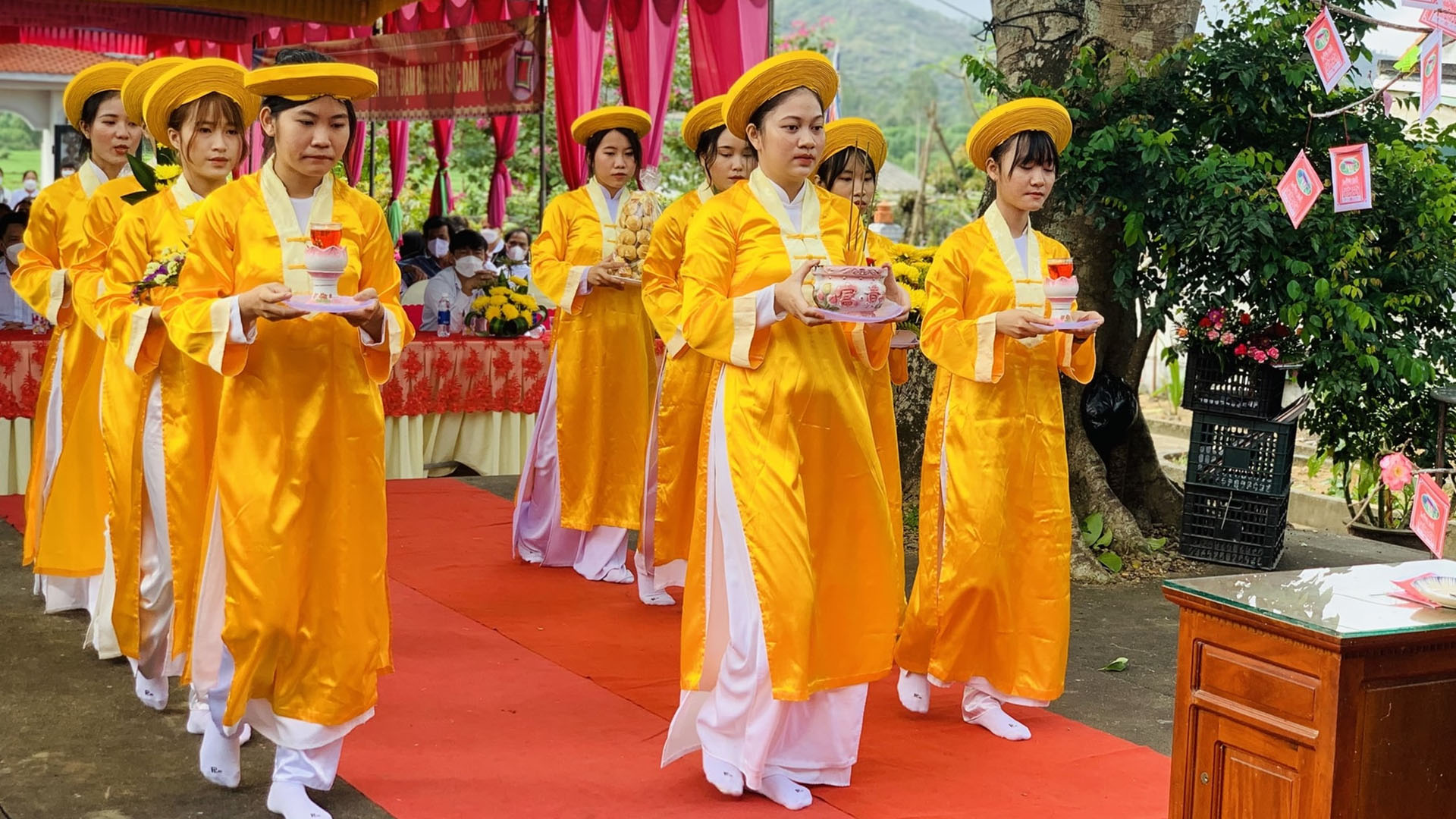
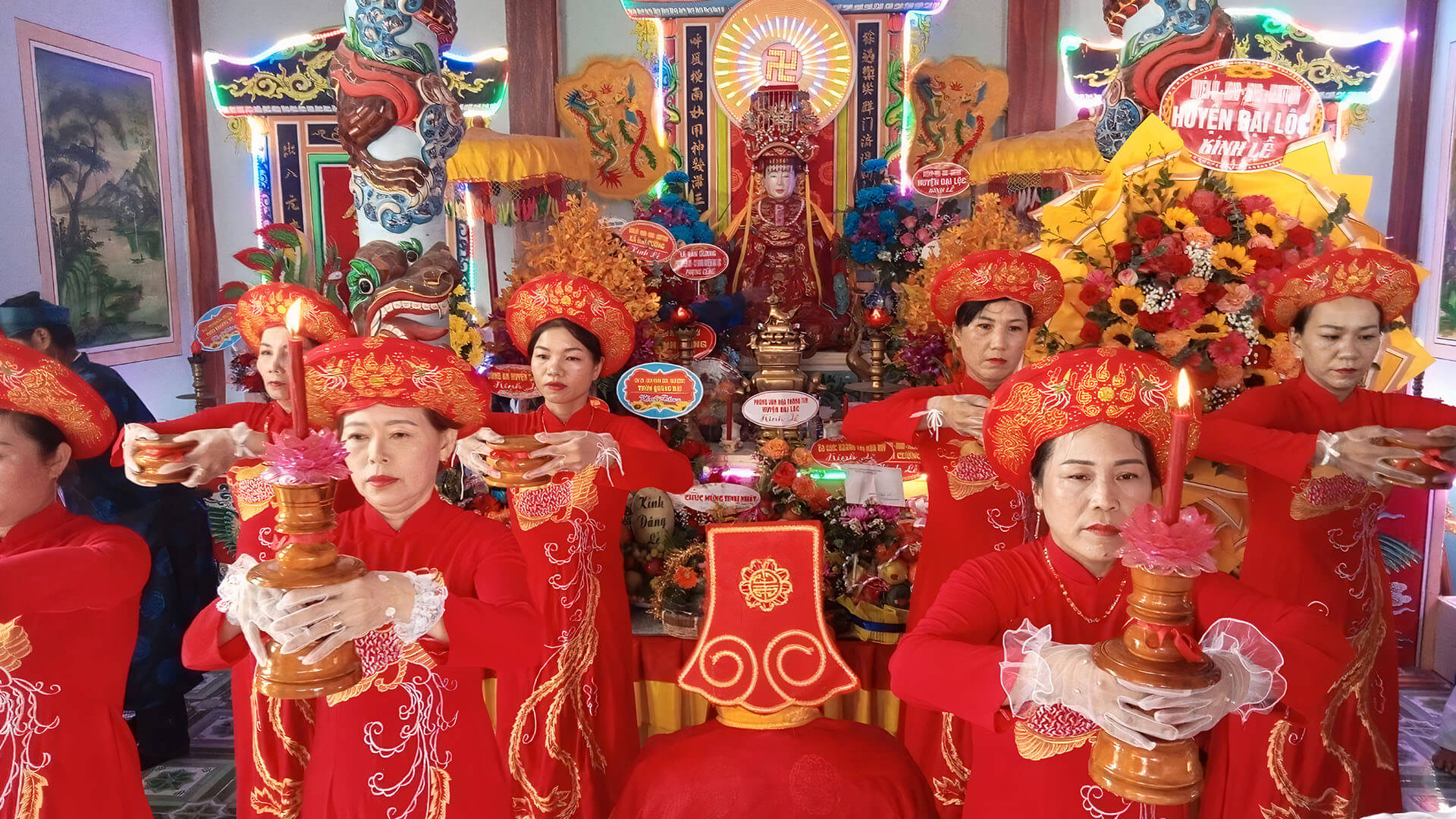
The Craft of Bamboo and Coconut House Construction in Cam Thanh, Hoi An has been recognized as a National Intangible Cultural Heritage. The conferment ceremony took place on the evening of September 27, 2024, on the occasion of the 60th anniversary of the Uprising for the Liberation of Cam Thanh Commune.
DA NANG CITY TOURISM PROMOTION CENTER