















The Archaeological and Architectural Relic of Dong Duong Buddhist Monastery (the Ruins of Dong Duong Buddhist Monastery) is located in Dong Duong Village, Binh Dinh Bac Commune, Thang Binh District, Quang Nam Province, now part of Dong Duong Commune, Da Nang City.
The Dai Nam Nhat Thong Chi of the Nguyen Dynasty recorded: “In Le Duong District, there are two towers in Dong Duong Hamlet. These two towers are about fifteen trượng apart, with one structure four trượng high, built of bricks, octagonal at the top and square at the base, each side measuring one trượng. About four trượng away lies an old foundation…” Dong Duong Buddhist Monastery only truly became known when French scholars published their research and excavation findings.
According to the inscription discovered at Dong Duong, in 875 King Indravarman II built a Buddhist monastery and a temple dedicated to the Bodhisattva protector of the dynasty, Laskmindra Lokesvara Svabhyada. The character of Mahayana Buddhism is clearly reflected in the content of the stele as well as in the sculptures at Dong Duong.
During the reign of Indravarman II, the capital of the Champa Kingdom was moved from the Panduranga region to Amaravati, with its new name Indrapura. According to some scholars, the site chosen for Indrapura was the present-day Dong Duong Village. The capital was located entirely within the Dong Duong plain, covering an area of about 2 km². (According to French researchers, Dong Duong means “sacred field,” with Duong being a variant of the Cham word Yan, meaning sky or sacred.)
This was a rectangular valley, surrounded on the east, south, and west by high hills and mountains. To the north flowed the Ly Ly River, where the discreetly arranged gateway provided access to the outside world.
The inscription also records the king’s devotion to Buddhism, stating that in 875, “Out of faith in Buddhism, the king established a Buddhist monastery (Vihara) and a temple dedicated to Laksmindra Lokesvara Svabhayada.” The stele also mentions the Pure Land (svargapura) or the “city of liberation” (moksapura), regarded as the “dwelling place” of the Buddha (Buddhapada).
The king emphasized that those who committed evil deeds would be condemned to hell. Upon completion of the construction, he made offerings of vast lands, wealth, slaves, and many other possessions to Lokesvara. The king decreed that after his passing, he would be given the posthumous title Paramabuddhaloka.
All these events demonstrate that King Indravarman II identified himself with the Buddha in the form of a Bodhisattva. During this period, Cham Buddhism followed the Mahayana tradition.
Dong Duong Buddhist Monastery was a renowned Buddhist center not only of the ancient Champa Kingdom but also of the broader Southeast Asian region during the medieval period. It was regarded as a Buddhist sanctuary due to the grand scale of its remaining architectural vestiges and its cultural influence on surrounding areas.
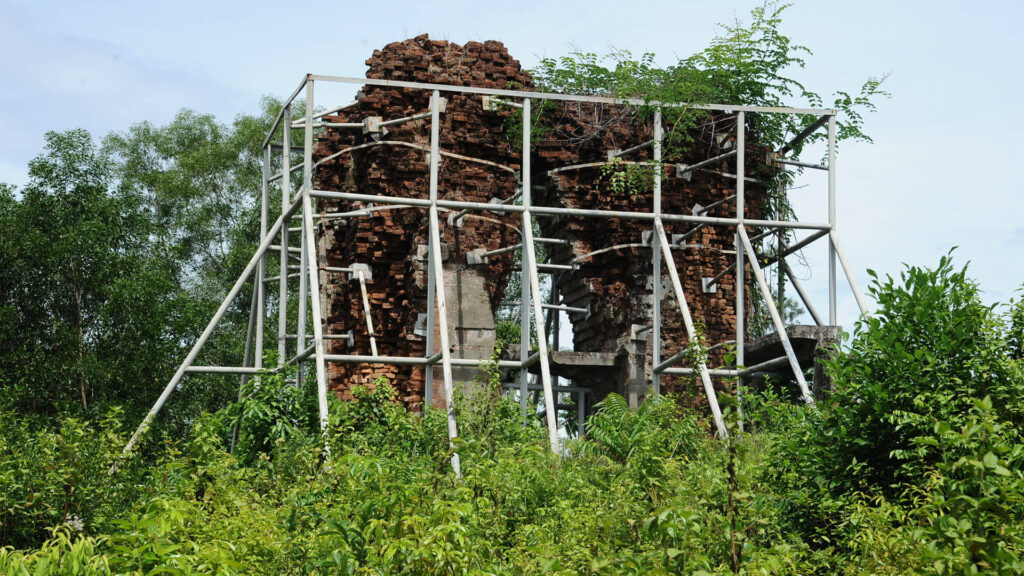
The site, however, was severely damaged by both natural elements and wars. Today, only a section of the tower wall, locally referred to as Thap Sang (the Bright Tower), remains, along with the foundations of architectural structures and some decorative architectural elements.
In 1901, the French scholar L. Finot conducted excavations at the Buddhist monastery and later published his study on the Dong Duong site, presenting 229 artifacts that were discovered. Among them, the most remarkable was a bronze Buddha statue over one meter tall, considered a masterpiece of perfection and among the finest works of art in Southeast Asia.
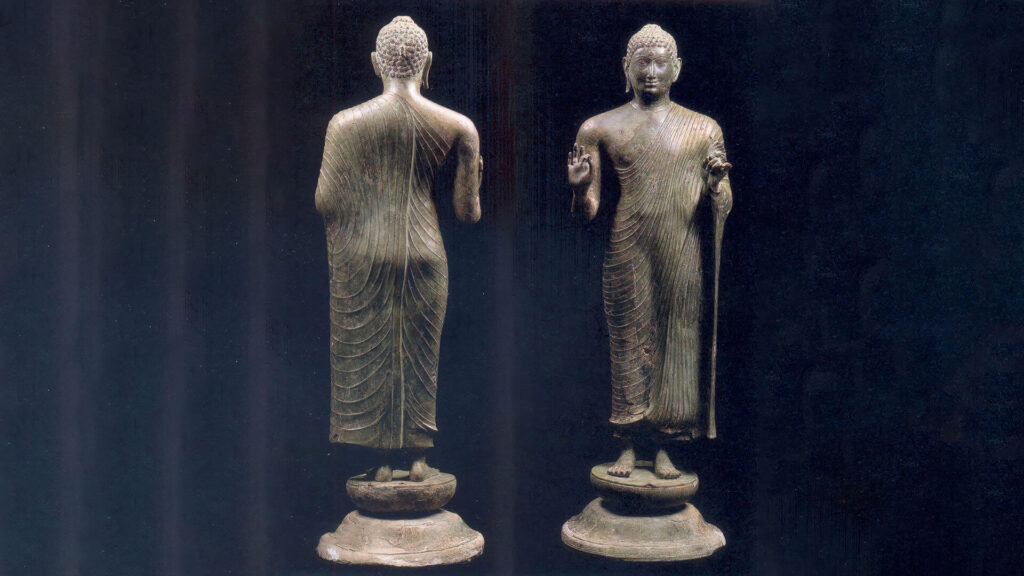
The bronze Buddha statue of Dong Duong, currently preserved at the Museum of History in Ho Chi Minh City, was recognized by the Government as a “National Treasure” under Decision No. 1426/QĐ-TTg, signed by Deputy Prime Minister Nguyen Thien Nhan on October 1, 2012, recognizing 30 national treasures in the first batch.
In 1902, H. Parmentier carried out large-scale excavations, which attracted researchers and led to the recognition of the site as one of the most important relics of Champa. The true stature and scale of Dong Duong Buddhist Monastery only became known when scholars published their research findings. At that time, H. Parmentier discovered the main architecture of this sanctuary along with many valuable sculptures.
According to his description, the entire main temple complex and surrounding towers were arranged along a west–east axis, stretching about 1,300 meters. In addition, he uncovered a system of brick foundations belonging to a monastery complex and lecture halls connected within a vast perimeter. The roof tiles discovered suggested a construction layout consisting of the main sanctuary for worship, monastic residences for the monks’ study and practice, and lecture halls for teaching.
It can be said that this was a model of a self-contained Buddhist monastery, ideally designed for the training of monks.
In September 1996, the Vietnam Institute of Archaeology, Hanoi National University, and the Quang Nam – Da Nang Museum jointly conducted a survey at Dong Duong Village. Archaeologists observed that, apart from the architectural remains of the Buddhist monastery, traces of human habitation from the Champa Kingdom period in Dong Duong Village were minimal.
The climate in the Dong Duong area is extremely harsh, with barren soil and a cultivable layer only about 40–50 cm thick, and in some places merely 20 cm, beneath which lies laterite rock. This was not a convenient location for establishing a capital city.
It can therefore be concluded that Dong Duong was purely a Buddhist sanctuary of the Champa Kingdom, while the capital Indrapura must have been a larger area situated outside the Dong Duong Buddhist Monastery complex.
The Dong Duong site is a vast architectural complex of a Buddhist monastery (vihara), consisting of numerous temple–tower ensembles.
The Buddhist monastery was a large architectural complex enclosed within a rectangular outer wall known as the outer citadel, with its longer side running along the east–west axis, measuring approximately 155m by 326m. The remaining foundation traces indicate that this was a fairly tall and substantial wall.
Within the outer citadel were three architectural clusters aligned on an east–west axis and three large artificial ponds: two located in the northeast corner and one in the southeast corner. Today, one of them has been filled in and converted into farmland. In addition, remnants of a long building can be found at the southeast corner of the outer citadel.
The outer citadel had two gates, east and west, although their remains are now very faint.
Inside the outer citadel stood the inner citadel, which enclosed the central temple containing the main tower. The inner citadel also featured a distinctive tower known as the Well Tower, located at its southwest corner, which today has been buried.
- The main temple complex was situated within a rectangular area, 326 meters long and 155 meters wide, enclosed by brick walls. From the main temple, a road about 760 meters long extended eastward to a rectangular valley. The main temple complex consisted of three architectural groups aligned along the east–west axis, separated from one another by brick walls.
- The eastern group now retains only the foundation traces of a long hall, which researchers identify as a Buddhist monastery (Vihara). This long rectangular hall had two parallel rows of columns aligned along the east–west axis, each row consisting of eight brick-built columns. The roof structure was made of timber and covered with tiles. Within this area stood a large sandstone altar intricately carved with human figures and delicate motifs.
- The central group now preserves only traces of wall bases and steps of a long hall oriented along the east–west axis. This hall had relatively thin brick walls, entrances located at both gable ends, and numerous windows along the two side walls, with a tiled roof. Within this area stood four large guardian statues (Dvarapala), each about 2 meters high, which researchers consider to be highly impressive works of Cham sculpture.
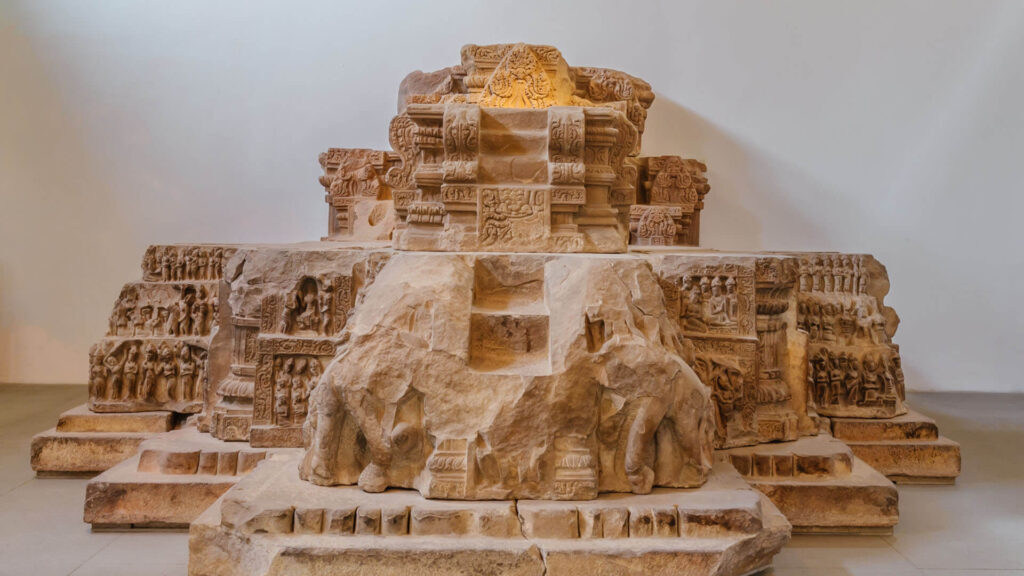
The Dong Duong Altar is currently on display at the Museum of Cham Sculpture in Da Nang. This altar was discovered at the main western tower, believed to have been dedicated to the Bodhisattva Lakshmindra Lokeshvara – the patron deity of the monastery.
The western group consisted of the main temples and surrounding subsidiary towers. These temples belonged to the traditional Cham architectural style, with a quadrilateral ground plan and an entrance facing east. In front stood a fairly long vestibule, while the wall surfaces were adorned with attached pilasters intricately carved with dense, entwined motifs of stylized foliage resembling worm-like patterns — a decorative style characteristic of the Dong Duong artistic tradition.
Around the base of the tower were decorative motifs of elephant heads alternating with miniature tower figures. Inside the temple stood a large sandstone altar, intricately carved with worm-like patterned bands, depictions of courtly life, and several scenes illustrating episodes from the life of the Buddha Shakyamuni.
During the discovery and excavation of the ruins of Dong Duong Buddhist Monastery, archaeologists unearthed many valuable artifacts, such as stone guardian statues, stone Buddha statues, a group of stone statues of Shiva, a bronze Buddha statue (a national treasure preserved at the Museum of History in Ho Chi Minh City), bronze goddess statues, and more.
Most of the sculptures from Dong Duong are displayed at the Museum of Cham Sculpture in Da Nang. The sculptures of Dong Duong gave rise to a renowned artistic style from the mid-9th century to the late 9th century, known as the Dong Duong style.
Dong Duong is an exceptionally unique Buddhist site of the Cham Kingdom, representing not only a significant heritage of Vietnam but also one of the rare Buddhist relics in the world from the ancient and medieval periods. Through its remaining artifacts, it reflects the golden age of a royal dynasty while elevating Cham sculpture to its pinnacle.
From a religious perspective, Dong Duong made a remarkable contribution to the Buddhist art of humanity, exemplary in its artistic expression, the meaning of its worship statues, reliefs, and compositions. It is also among the rare surviving ancient Buddhist relics in both Vietnam and Southeast Asia.
The relics and artifacts at the Dong Duong site embody the distinctive characteristics of a developmental stage in Cham architecture and sculpture, which scholars, in their studies, have termed the Dong Duong artistic style — “one of the most distinct styles of Cham sculptural art.”
In terms of architecture, researchers have identified the fundamental characteristics of the Dong Duong style: “… few styles possess a more distinct individuality than the Dong Duong style. It is within this style that the uniqueness and strangeness of Cham art are most vividly expressed.”
In terms of architectural sculpture, the carvings of this style are entirely distinctive. According to researchers, there are three major features that identify the Dong Duong style:
- Anthropological traits – Human figures strongly reflect Cham ethnic characteristics: thick lips with a marked outline; a thick, bushy mustache sometimes covering the mouth, making the upper lip appear thicker and longer than the lower; broad, flat noses; and highly arched eyebrows that meet in the middle.
- Ornamental motifs – Decorative patterns often consist of worm-like leaves arranged in succession, or spiraled leaves curling outward on both sides, creating a unique stylistic identity.
- Floral and symbolic ornaments – Large lotus-like flowers in the shape of a bodhi leaf frequently appear on crowns and jewelry; round earrings adorned with large blossoms; and occasionally serpent heads used as decorative elements on jewelry and belts.
From the results of research and excavations, it can be affirmed that the Dong Duong artistic style was also widely present in architectural sculptures across various provinces such as Quang Binh, Quang Tri, Thua Thien – Hue, Quang Nam, Quang Ngai, and Khanh Hoa. Numerous inscriptions from this period found in different locations—such as Ron Stele (Quang Binh), Nhan Bieu Stele (Quang Tri), Phu Luong and Lai Trung Steles (Thua Thien – Hue), Bang An, Bo Mung, Ban Lanh, An Thai, Lac Thanh, Hoa Que (Quang Nam), and Chau Sa (Quang Ngai)—all demonstrate that the Indrapura dynasty was a prosperous era marked by development in many fields and regions of the Cham people.
These characteristics have been identified as criteria for determining the chronology and classification of Cham sculptures belonging to the Indrapura period (9th–10th centuries). The influence of this artistic stage spread widely across the territory of the former Cham Kingdom. The Dong Duong artistic style marks an important phase in the developmental course of Vietnam’s architecture and art.
With its outstanding and distinctive values, the archaeological and architectural relic of Dong Duong Buddhist Monastery (now in Dong Duong Commune, Da Nang City) was designated by the Prime Minister as a Special National Relic under Decision No. 2499/QĐ-TTg dated December 22, 2016.
DA NANG TOURISM PROMOTION CENTER