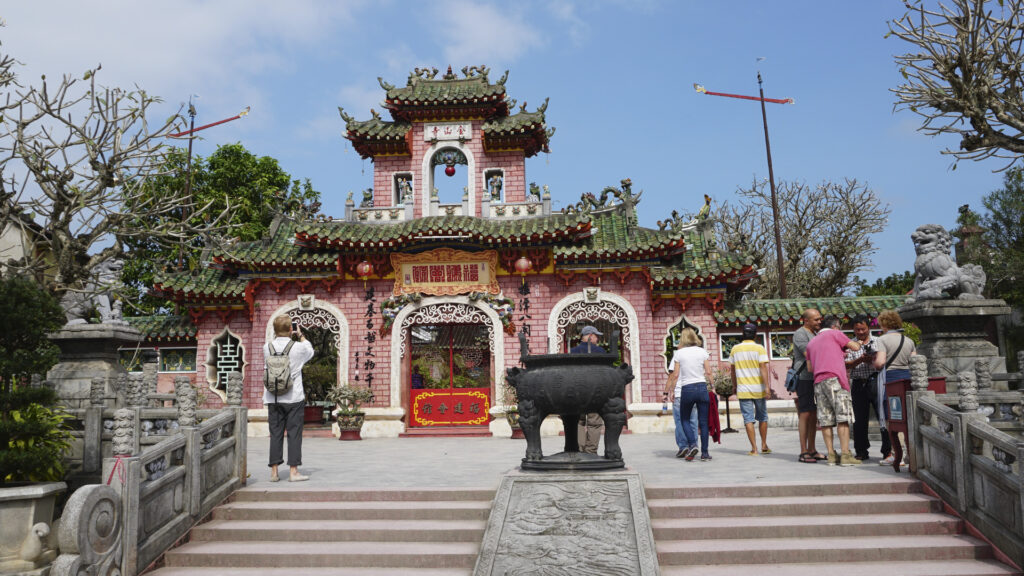
















Amid the lively city, the soul finds solace in the serene and idyllic setting of the Hai Chau Village Communal House complex.
Alley 48, Phan Chau Trinh Street, Hai Chau 1 Ward, Hai Chau District
The Hai Chau Village Communal House is situated prominently in the heart of Da Nang City, on the left bank of the Han River (Alley 48, Phan Chau Trinh Street, Hai Chau 1 Ward, Hai Chau District). According to the historical genealogy of the Nguyen Van lineage, one of the 43 lineages of Hai Chau village, the ancestors who cultivated and developed Hai Chau village originated from Hai Chau village, Tinh Gia district, Thanh Hoa province. They established Hai Chau village and settled in this area at the end of the 15th century, following King Le Thanh Tong to reclaim the land.
Per historical accounts, in the 5th year of King Gia Long (1804), the village officials of Hai Chau submitted a request to King Gia Long to erect a communal house for the worship of the village deity and the village’s ancestors at Nghia Loi land by the Han River. Unfortunately, the communal house suffered severe damage during the French colonial invasion of 1858.
Two years later, the villagers began reconstructing the communal house at the current location, now occupied by Da Nang Technical Medical University (99 Hung Vuong Street). In 1903, the French authorities took over the communal house to provide treatment for patients during a smallpox epidemic.
A year later, the communal house was returned to the villagers following their request. However, the villagers believed that the house had been significantly defiled. Consequently, they petitioned King Thanh Thai to authorize the construction of a new communal house at the present location (Unit 3, Hai Chau 1 Ward, Hai Chau District), where it remains today.
The Hai Chau Village Communal House underwent its third reconstruction, which included the village communal house, the ancestor temple, the temple of 43 clans, Miếu Bà – Ba Temple (dedicated to Saint Mother Thien Y Ana), the three-arched-entrances gate, and a pond.
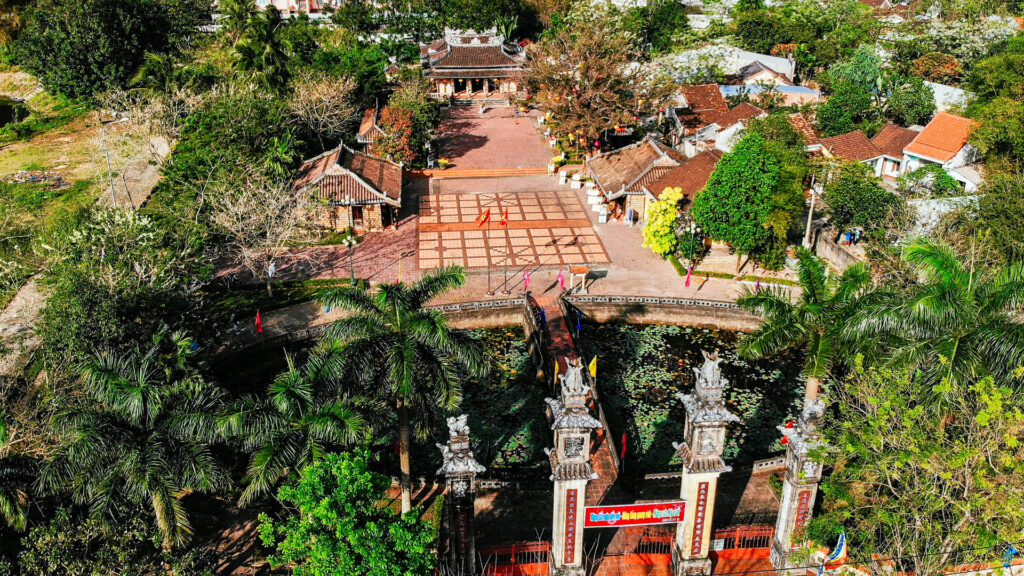
The architectural design of the Hai Chau Village Communal House, dating back to 1904, boasts a harmonious and dignified layout. The entire complex, comprising the communal house, the three-arched-entrances gate, and the lotus pond, is aligned along the North-South axis. The relic area, housing the communal house, the ancestor temple, the temple of 43 clans, and the Ba Temple, is arranged along the East-West axis. The façade is oriented southward, with the main communal house at the center, the ancestor temple and Ba Temple to the east, and the temple of 43 clans to the west.
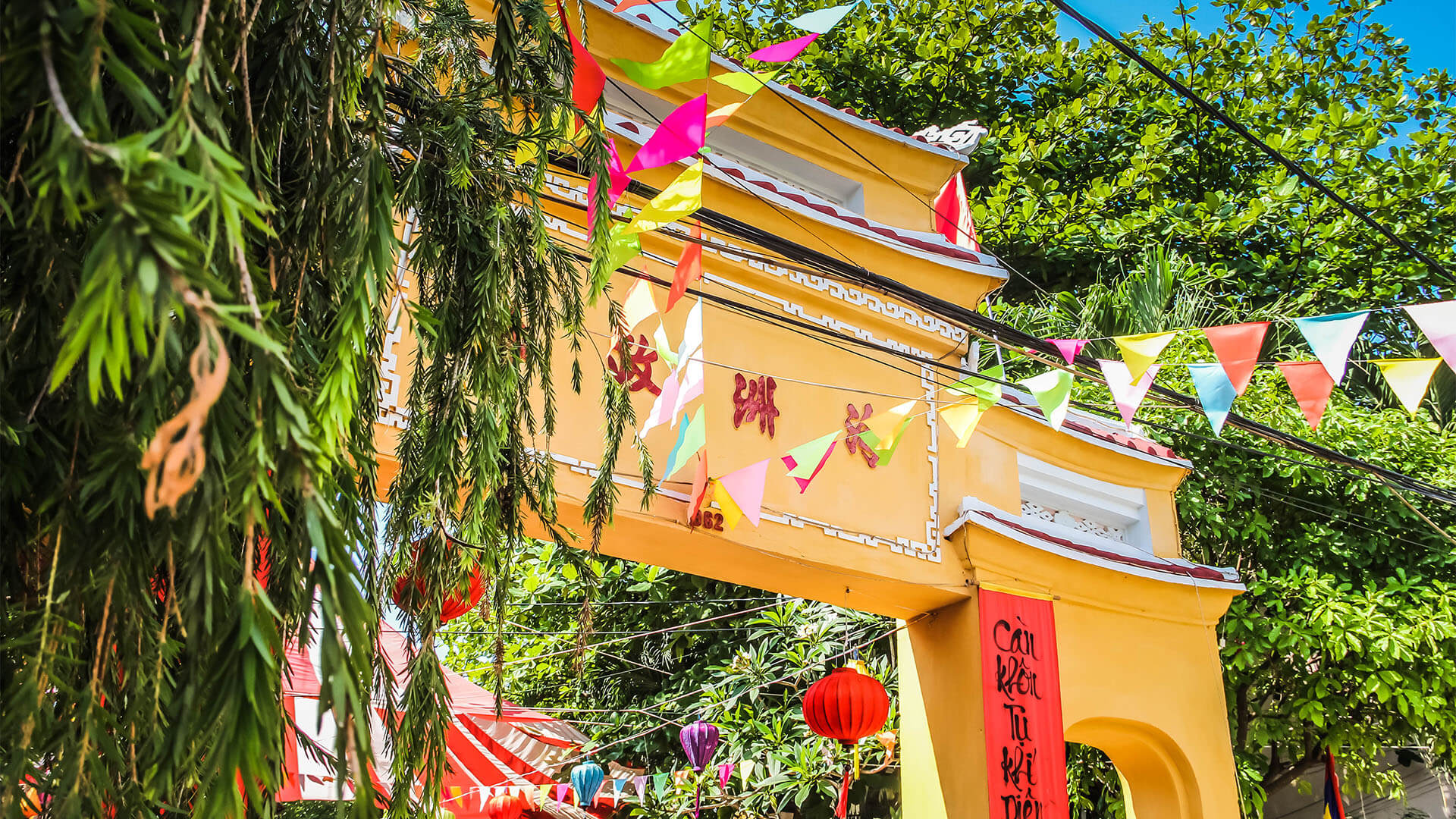
The three-arched-entrances gate comprises a central main door and two side doors. It measures 6 meters in length and 5 meters in height. The main door is adorned with four embossed Chinese characters under the eaves, translating to “Hai Chau Main Village”.
The Hai Chau Village Communal House relic complex is a significant historical site in Da Nang, Vietnam. The communal house, measuring 22.2m in length and 11m in width, is part of a larger 36m by 25m communal yard. It consists of three sections: the veranda, the rear hall, and the back chamber. The back chamber uses a wooden frame architecture system with engraved horizontal beams and crossbars. The truss system features a decorative wooden beam at its center and is supported by eight wooden columns divided into three compartments. The outer wooden columns are adorned with dragon and cloud motifs painted on a thin layer of cement and do not have stone bases at their foot.
Constructed in an inner-city village, the communal house reflects the construction and development of Hai Chau village throughout history.
Although it has suffered deterioration and severe damage over time, the communal house has been repaired three times, in 1926, 1937, and 1957. During the second repair in 1937, the Nguyen Van clan requested to separate.
Recognizing its cultural and historical significance, the Ministry of Culture and Information (now the Ministry of Culture, Sports, and Tourism) designated the Hai Chau Communal House and clan ancestor temple as national cultural and historical relics on July 12, 2001. Following this recognition, the Da Nang City People’s Committee invested in the restoration of the communal house and ancestor temple complex with the support of the Ministry of Culture and Information in early 2002.
Enduring the dust of time and the destruction of war, the Hai Chau Village Communal House has severely deteriorated. According to Mr. Nguyen Duy Minh, the cultural officer of Hai Chau 1 ward, the communal house has been repaired three times, in 1926, 1937, and 1957. During the second repair in 1937, the Nguyen Van clan requested to separate.
Before the repairs, the relic complex had a total area of 1,512m2 and a pond; after the repairs, the complex had a total area of 3,150m2 and a pond.
On July 12, 2001, the Ministry of Culture and Information (now the Ministry of Culture, Sports, and Tourism) recognized Hai Chau Communal House and the clan ancestor temple as national cultural and historical relics. In early 2002, with the support of the Ministry of Culture and Information, the Da Nang City People’s Committee invested in restoring the Hai Chau communal house and ancestor temple complex.
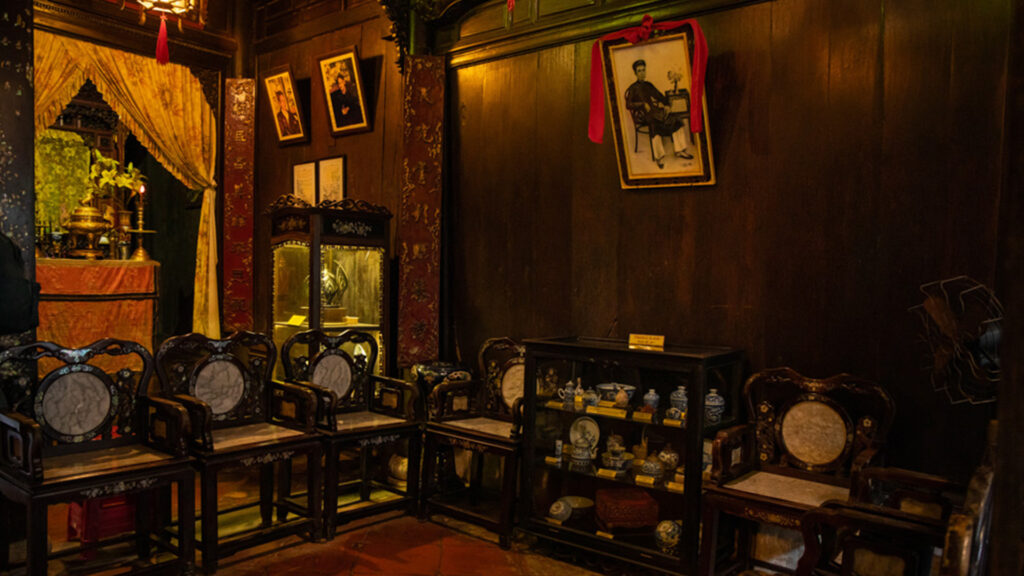
The Hai Chau Village Communal House relic complex has a rich historical and folk cultural artifacts collection. Notably, a 1.3m high bronze bell with a mouth diameter of 0.7m, adorned with two Nguyen dynasty dragons, is prominently displayed at the Da Nang Museum. Additionally, the communal house hosts three marble inscription steles. One was erected in the 14th year of Tu Duc (1861), and the other two in the first year of Bao Dai (1926) to commemorate the generous contributions of the Hai Chau community in repairing the communal house. Currently, the communal house retains two steles on each side at the rear of the communal yard.
In 2005, after extensive repairs, the Hai Chau Village Communal House was reopened to the public. Emphasizing restoration and preservation, great care is taken to safeguard this important relic. Annually, numerous students from the city and tourists visit the communal house to gain insights into the village’s distinctive cultural heritage.
DANANG CENTER FOR TOURISM PROMOTION